In the family’s voice
When he trained his pen to follow his imagination
How Kamal Ruhayyim began writing literature
Kamal Ruhayyim loved knowledge and reading all his life, but what set him apart most in everything he did was a constant striving for mastery.
For him, perfection did not simply mean doing a job well or winning other people's admiration. He was looking for a level of mastery that no one but he could define: a level at which he himself felt he was coming close to what he had set out to achieve.
Perhaps this trait of his character is the key to understanding the way he began his journey with literature.
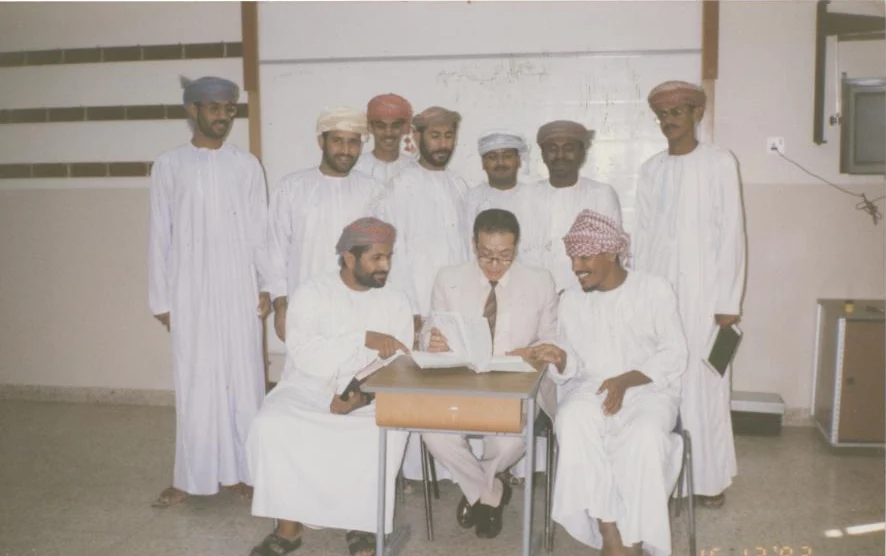
I remember, as a child, the years we lived in the Sultanate of Oman. My father had more time then, and it allowed him to devote himself more fully to one of his deepest interests: reading and writing.
He had already read an enormous amount of literature, from Arabic and Egyptian novels to Russian and French literature, and literary works translated from many parts of the world.
But when he wanted to write literature himself, all the novels he had read were not enough for him.
He decided to study writing itself.
He began reading dozens of books on literary criticism and the craft of writing, studying in depth how literary works are built, and how a writer can turn his ideas and imagination into a living text.
And I remember that he spent months practising writing.
He wanted to reach the point where his pen would respond completely to what his mind imagined: to describe things as he saw them in his imagination, to enter his characters and become them, and then to carry all of it onto the page exactly as he wanted.
It was not merely a search for the right words, but a long training so that writing would become a tool able to express his inner world.
He trained his pen until it could write what he imagined, not merely what his pen was able to write.
He began with short stories.
Those were the literary beginnings I remember, and he wrote beautiful stories that encouraged him to take a bigger step into the world of the novel.
Then came the idea of a novel about the search for the self and the confrontation with fanaticism, told through the story of Galal in “The Jewish Muslim”.
That was the beginning of his entry into a wider world of fiction, a world in which he could use what he had read, learned and practised, and give the characters and events the space his imagination needed.
When I look back at that period today, what I find most worth pausing on is not only what my father wrote afterwards, but the way he prepared himself to write.
He was a voracious reader before he became a novelist, and a diligent student of the art of literature before he offered his works to readers.
Perhaps this was one of his most important traits: however much he knew, he never believed that loving something was enough, on its own, to master it.
Before Kamal Ruhayyim built his fictional worlds, he spent a long time learning how to give his imagination the language it deserved.
As told by his son Ahmed